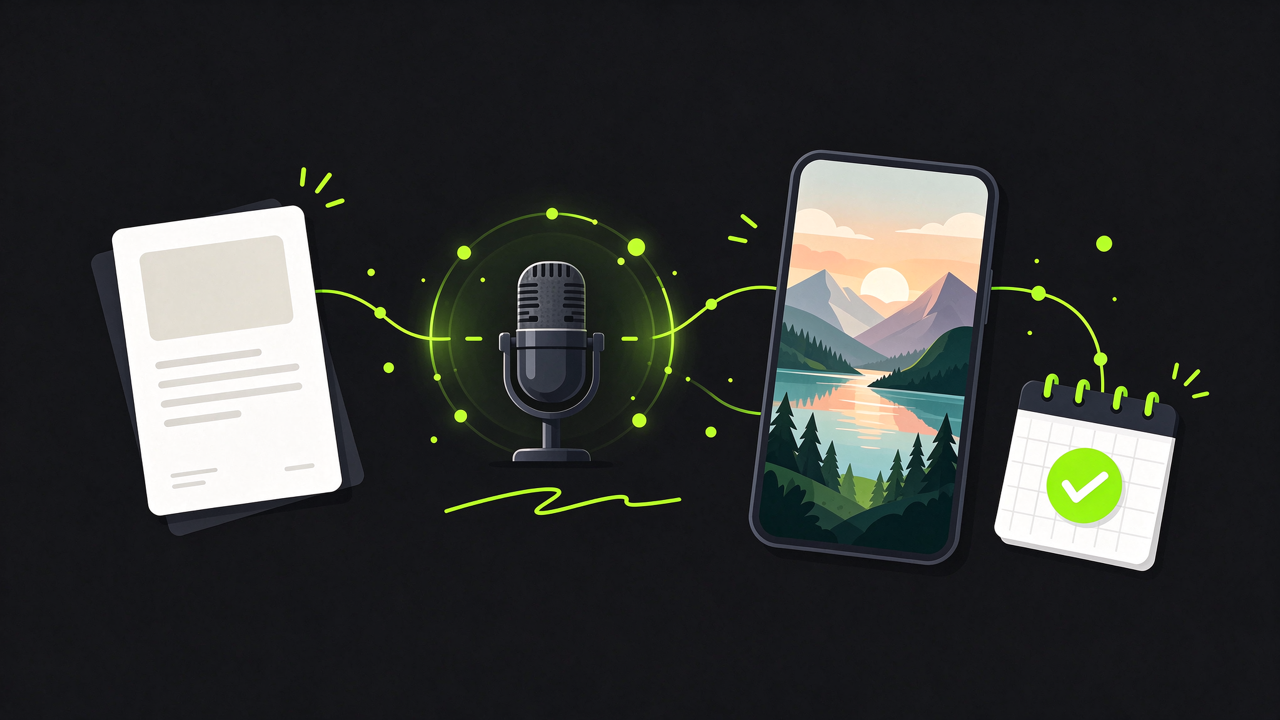
Faceless reels are short vertical videos where the value comes from the script, voice, and visuals instead of a person on camera. No filming, no lighting setup, no bad hair day. You build one repeatable pipeline and run it every day.
This guide walks through the whole thing: choosing a niche, writing a script that holds attention, producing the voice and visuals, checking the result before it ships, and keeping a posting rhythm you can actually sustain.
What a faceless reel actually is
A faceless reel is a 15–60 second vertical video made of three layers:
- A script that delivers one idea in the first two seconds.
- A voice — your own recording, a licensed voice actor, or a synthetic voice you have the rights to use.
- Visuals — stock footage, animation, generated art, or simple text-on-screen, cut to the beat of the voice.
The format works because viewers stay for the idea, not the person. That also means the idea has to be strong. A faceless account with weak scripts has nothing else to fall back on.
Step 1: Pick a niche that survives 30 videos
Most people quit faceless content because they pick a niche they can only talk about five times. Before you write anything, answer two questions:
- Can I list 30 specific topics in this niche in ten minutes?
- Do people already search for or save this kind of content?
Niches that hold up well: history and mythology, psychology and human behavior, personal finance basics, AI tools, health explainers, true stories, productivity systems, and oddly specific "how things work" content. Niches that usually die fast: generic motivation quotes, "day in the life" without a person, and anything that needs a real face to land the joke.
Write the 30 topics down before you produce video one. It is the cheapest way to find out whether the niche has legs.
Step 2: Write the script backwards from the last line
Start with the point you want people to remember, then work backwards to the hook. A working structure:
- Hook (0–2s): one sentence that names the payoff or breaks an assumption. "Your phone charges slower on purpose." Not "In this video I'll explain charging."
- Setup (2–8s): the minimum context needed to understand the payoff.
- Turn (8–20s): the surprising part — the reason, the trick, the number.
- Payoff (20–40s): deliver what the hook promised, in plain words.
- Close (last 3s): one line that either loops back to the hook or asks for a save.
Keep it under 120 spoken words for a 40-second reel. If you cannot say it out loud in one breath per sentence, the script is too dense.
Step 3: Choose a voice that matches the niche
Three options, each with a trade-off:
- Your own voice. Best trust, zero cost, but you need a quiet room and consistent delivery.
- Licensed voice actor. Good for documentary and storytelling niches, costs money per video.
- Synthetic voice. Fast and scalable, but quality varies and some platforms label AI audio.
Whichever you use, keep the same voice across videos. Recognition is half of retention. Also check usage rights: a synthetic voice is only safe if your plan allows commercial use on social platforms.
Record or generate the voice before you touch visuals. Editing to a voice track is far faster than fitting a voice to a finished edit.
Step 4: Build visuals that survive a 5-inch screen
The visuals have three jobs: hold attention during the voice, make the topic legible without reading, and look consistent enough that people recognize you in the feed.
Practical rules:
- One idea per shot. If a shot needs explaining, cut it.
- Change something every 2–4 seconds. Cut, zoom, pan, or a new overlay. Nothing should sit still long enough to look like a mistake.
- Text lives in the safe zone. Keep captions out of the bottom 15% and the top 10% — that is where platform UI sits.
- Use a repeatable style. The same font, the same two or three colors, the same transition. Consistency is cheaper than creativity and it compounds.
Stock footage, animation, and generated art all work. What does not work is a slideshow of unrelated images with no relation to the words.
Step 5: Review before you publish
This is the step most people skip, and it is where accounts get hurt. Before anything goes out, check:
- Does the first two seconds state the payoff?
- Does every claim have a source you would defend in public?
- Are captions correct, including names and numbers?
- Is the audio level consistent between videos?
- Does it look like your other videos?
- Would you be comfortable if this video got 10x the views?
If a video fails three or more of these, fix it or drop it. Posting something weak costs more than skipping a day.
Step 6: Pick a cadence you can hold for a quarter
Daily posting is the fastest path to growth and the fastest path to burnout. A sustainable starting point is three to five reels per week, produced in one batch session, scheduled ahead.
Batch production looks like this:
- Write five scripts in one sitting.
- Record or generate all five voices.
- Build all five videos.
- Review them together, side by side.
- Schedule them across the week.
Batching keeps the style consistent and removes the daily "what do I post today" decision. Consistency beats intensity over a quarter.
Common mistakes
- Hooks that describe the video. "Today we're talking about X" gives the viewer no reason to stay.
- Too many ideas in one reel. One reel, one idea. Save the rest for later videos.
- Voices that change every upload. Viewers recognize audio before they recognize visuals.
- Chasing trends outside your niche. A viral video that brings the wrong audience does not help.
- No review step. One unsourced claim can cost you the account.
Where Faceless Reels fits
Faceless Reels runs this whole pipeline as one workflow: you give it an idea, it drafts the script, records the voiceover, assembles the vertical video in a consistent art style, and queues it for a schedule. Every video goes into a review step before it publishes, so you approve what goes out instead of discovering it in the feed.
If you want to skip the editing stack and keep the review step, that is the shortcut worth taking. If you would rather build the pipeline yourself, the steps above are the whole blueprint — the tools change, the order does not.